


The science and technology difference can clarify their roles. Many people ask, is science the same as technology? These fields connect but serve different purposes; science explores nature and society, answers questions, and expands knowledge.
Technology applies scientific knowledge to create tools, systems, and solutions that improve our lives. This article examines both fields’ definitions, methods, and historical development. It also covers their real-world teamwork, social impact, and common misconceptions.
By the end, you will better understand the relationship between science and technology and their separate roles in society. Join us as we clarify these essential concepts.
Key Takeaways
- Science seeks to understand the world, while technology applies that knowledge.
- Both fields are interconnected but serve distinct purposes.
- Exploring their history reveals how they have evolved together.
- Real-world collaboration showcases their practical importance.
- Common misconceptions can obscure their unique contributions.
Defining Science: What It Means and What It Covers
The definition of science is a systematic way to understand the natural world. It gathers evidence, forms hypotheses, and tests ideas through observation and experiments. This work builds reliable knowledge over time through field research, mathematical reasoning, historical analysis, and surveys.
At its core, science seeks answers about the universe. It offers a framework for exploring everything from tiny particles to vast cosmic structures. Albert Einstein once said:
“Science without religion is lame, religion without science is blind.”
This quote highlights the value of both perspectives in our search for knowledge.
The Scientific Method as the Foundation
The scientific method guides scientific inquiry. It uses key steps to help researchers make credible findings. Scientists observe phenomena, form testable hypotheses, design experiments, collect data, and analyze results.
When evidence challenges their assumptions, scientists revise their conclusions.
Related Posts:
- How Many Fields Are There in Information Technology…

- What is Network Switching Technology The Backbone of…

- What is Intel Smart Connect Technology Keeping Data Updated

- How Technology is Used in Schools Enhancing Learning

- How Technology Could Best Be Used to Solve This Problem

- How Technology Affects Critical Thinking The Digital Impact

Observation, Hypothesis, and Experimentation
Observation begins the scientific method. It helps scientists identify patterns and raise questions. Next, they form a hypothesis, a testable statement that predicts an experiment’s outcome.
Experimentation follows through controlled tests that gather data.
Peer Review and Reproducibility
Peer review helps validate scientific work. Before publication, other experts in the field examine the findings. This process checks their accuracy and credibility.
Reproducibility lets other scientists repeat the results. It strengthens the reliability of scientific claims.
Major Branches of Science
Science has several major branches, each studying a different part of our world. The three main categories are natural sciences, social sciences, and formal sciences.
Natural Sciences, Social Sciences, and Formal Sciences
Natural sciences study the physical world, including biology, chemistry, and physics. Social sciences, including sociology and psychology, study human behavior and societies. Formal sciences use mathematics and computer science to study abstract ideas and logic; each uses unique methods and evidence.
Defining Technology: What It Means and What It Covers
Technology means using knowledge and skills to solve practical problems. It includes tools, systems, and organized methods that meet human needs or reach clear goals. Technology covers more than electronic devices.
Examples include agricultural tools, medical procedures, transportation systems, construction methods, manufacturing processes, software, and communication networks. People craft, test, improve, implement, and maintain these technologies in real-world settings. They must work well for their intended purposes.
The definition of technology highlights the value of applied knowledge. This means technology turns theoretical concepts into practical solutions. For example, a new medical device uses scientific principles, but its success depends on meeting healthcare providers and patients’ needs.
People often judge technology by its usefulness, safety, reliability, efficiency, affordability, and social impact.
Tools, Systems, and Applied Knowledge
At its core, technology combines tools and systems that support human activities. Tools may be simple hand-held implements or complex machinery, while systems organize tools and processes toward a shared goal. In agriculture, machinery, irrigation systems, and data analysis form a technological ecosystem that increases productivity.
Categories of Modern Technology
Modern technology includes several technology categories, each with distinct features and uses. These categories include:
- Information Technology: This field focuses on computers, software, data management, and networks. It plays a crucial role in how information is processed and shared across various platforms.
- Biotechnology: This area utilizes biological systems and organisms to develop products and processes. It is essential in sectors like healthcare, agriculture, and environmental conservation.
- Energy Technology: This category encompasses the development, conversion, storage, and distribution of energy. It includes renewable energy sources and innovations aimed at improving energy efficiency.
Each of these technology categories makes an important contribution to society. For more insights into the various fields within technology, explore this comprehensive guide.
Is Science the Same as Technology? The Core Question Answered
Asking “is science the same as technology” helps us understand both fields. Science and technology often intersect, but they serve different purposes. Science explains the natural world, while technology creates practical applications and solutions.
Many people confuse science versus technology because the fields are closely connected. Both fields use specialized knowledge, research, and experiments. Scientific knowledge, such as electromagnetic theory, has supported technologies like wireless communication.
In turn, technological advances can improve scientific research, making it more precise and efficient.
Why People Confuse the Two
People often confuse them because STEM combines Science, Technology, Engineering, and Mathematics. This label can make the fields seem synonymous. The science and technology relationship is close, but each field makes a unique contribution.
Science asks questions about the universe. Technology applies those answers to create tools and systems that improve our lives.
The Short Answer and Why It Matters
The short answer is no: science is not the same as technology. Knowing this difference matters for education, policy-making, and responsible decision-making.
Research funding often depends on knowing the difference between scientific knowledge and technological application. Confusing them can create ineffective policies and slow progress.
“Science and technology are not the same, but they are deeply intertwined in shaping our future.”
| Aspect | Science | Technology |
|---|---|---|
| Purpose | Understanding natural phenomena | Practical applications and solutions |
| Approach | Theoretical and experimental | Applied and innovative |
| Outcome | Knowledge and theories | Products and processes |
Key Differences Between Science and Technology
Understanding the differences between science and technology helps explain their roles in society. They connect, but they have different goals and methods.
Goals and Objectives
The main aim of science is to discover, describe, explain, and predict natural phenomena. Scientists use systematic research to support scientific discovery and find principles that govern different processes. Technology goals focus on technological application by creating or improving tools, systems, and processes for real-world problems.
In short, science goals center on discovering and understanding natural phenomena.
- Science Goals: Discovery and understanding of natural phenomena.
- Technology Goals: Application of knowledge to solve practical issues.
Discovery vs. Application
Science and technology ask different questions. Science asks, “How does this process work?” Science seeks understanding, while technology seeks useful applications.
Process and Methodology
The methods used by science and technology show their differences. Science values open-ended inquiry, transparent evidence, and conclusions open to revision. Scientists embrace uncertainty and seek to understand complex systems.
Technology uses design requirements, performance specifications, and constraints. Technologists test and optimize solutions while considering user needs, cost, safety, and implementation.
Research and development often combine these approaches, creating synergy that supports innovation. This collaboration can produce breakthroughs that benefit both scientific discovery and technological application.
Open Inquiry vs. Problem-Solving
Science encourages exploration and questions, while technology centers on problem-solving and practical use. Knowing these differences clarifies how both fields advance knowledge and improve daily life.
How Science and Technology Overlap and Intersect
The science and technology overlap shows a relationship that drives innovation. Together, these fields form an innovation ecosystem that expands knowledge and human abilities. Their shared work leads to major advances.
Professionals in both fields use many of the same skills and areas of knowledge. These include quantitative reasoning, data analysis, modeling, design, experimentation, critical thinking, communication, project management, and ethical judgment. These skills help people solve complex challenges and support innovation.
Shared Skills and Knowledge Bases
Scientific research often relies on many technologies. Microscopes, satellites, sensors, supercomputers, gene sequencers, and imaging systems are crucial scientific tools. They help researchers gather and analyze data, improve research quality, and explore new frontiers.
Conversely, scientific discoveries help create new technologies. For instance, research principles advance materials, medicines, software, energy systems, and manufacturing methods. This reciprocal relationship shows the importance of the science technology connection.
Mutual Influence and Feedback Loops
The science technology connection includes mutual influence and feedback loops. Better instruments produce better data, which supports stronger theories that create more capable technologies and new research opportunities. This cycle shows how progress in one field can produce breakthroughs in the other.
Interdisciplinary research teams include scientists, engineers, designers, clinicians, computer specialists, policymakers, and users. These teams show how collaboration can solve complex problems and drive innovation within the innovation ecosystem. This partnership lets creativity and knowledge flourish.
| Aspect | Science | Technology |
|---|---|---|
| Focus | Understanding natural phenomena | Application of knowledge |
| Methods | Experimental and theoretical | Design and implementation |
| Outcome | Theories and principles | Tools and systems |
| Skills Required | Analytical and critical thinking | Problem-solving and creativity |
The Historical Relationship Between Science and Technology
From ancient practices to current advances, the history of science and technology shows a deep connection. This relationship changed across eras, shaping how people understand and use both fields.
Early societies made major gains in technological development before formal scientific theories existed. Ancient civilizations built irrigation systems, navigational tools, and architectural marvels. They used observation and craftsmanship, not structured scientific inquiry.
As one historian noted, “The ingenuity of ancient peoples laid the groundwork for future scientific exploration.”
Early History: From Antiquity to the Industrial Revolution
The roots of the history of science and technology reach back to antiquity. Early humans used their environment, developing metallurgy and calendars. These advances supported agriculture and trade.
The Industrial Revolution marked a turning point when science joined engineering and manufacturing. Steam engines and mechanized production transformed industries and daily life.
The 20th and 21st Centuries: Convergence and Acceleration
As the 20th and 21st centuries began, science and technology advanced faster. Physics, chemistry, and biology increasingly overlapped. Aviation, electronics, and biotechnology show this convergence.
The rise of digital networks and artificial intelligence shows how modern innovation depends on scientific progress.
Throughout history, science and technology have influenced each other. Technologies enabled new scientific measurements. Scientific understanding guided design and production.
| Era | Key Developments | Impact |
|---|---|---|
| Antiquity | Irrigation, Metallurgy | Foundation for agriculture and trade |
| Industrial Revolution | Steam Engines, Mechanization | Transformation of industries |
| 20th Century | Aviation, Electronics | Global connectivity and communication |
| 21st Century | Biotechnology, AI | Innovations in healthcare and technology |
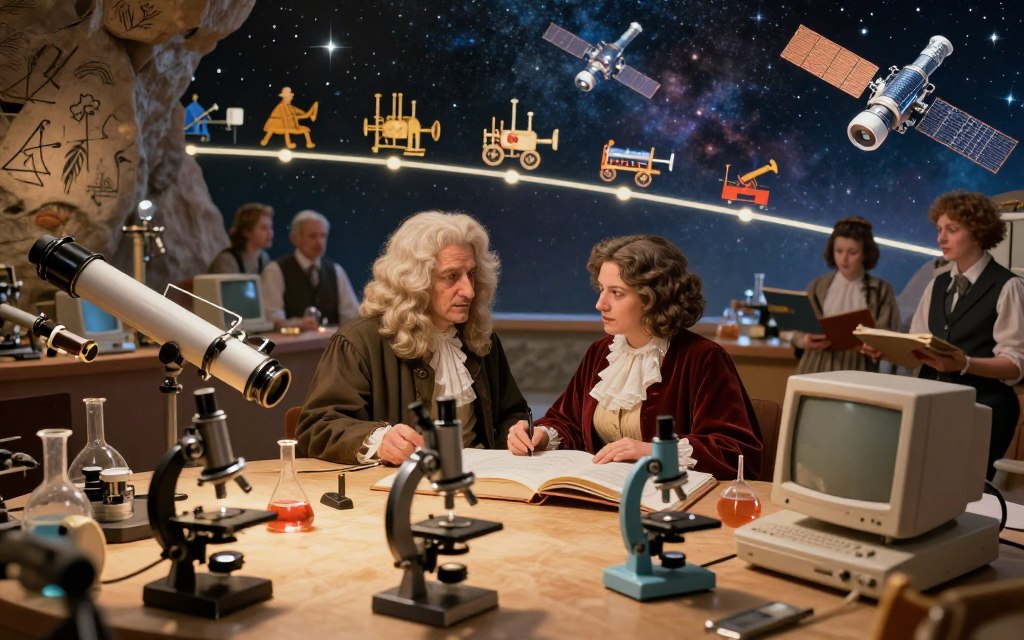
Real-World Examples of Science and Technology Working Together
Science and technology examples show how research and inventions improve daily life. This teamwork has major effects in medicine, healthcare, space exploration, and aerospace.
Medicine and Healthcare Innovation
In medicine, healthcare innovation has changed how we find and treat diseases. Scientific research supports vaccines, diagnostic tests, and pharmaceuticals. Medical technology, including MRI scanners and robotic surgical systems, helps prevent, diagnose, monitor, and treat illnesses.
Electronic health records and genomic sequencing have also changed patient care. They improve diagnosis accuracy and support treatment plans tailored to each patient. Clinical validation, regulation, patient safety, privacy, and equitable access remain essential.
Space Exploration and Aerospace
Space exploration technology brings science and technology together. Astronomy, physics, and materials science guide spacecraft, launch vehicles, and satellite design. These tools help us explore distant planets and collect vital data about our universe.
Aerospace science improves daily life through better weather forecasting, GPS, and communication systems. Researchers, engineers, and government agencies work together to develop these technologies. They expand exploration and improve our experiences on Earth.
| Field | Scientific Contributions | Technological Innovations |
|---|---|---|
| Medicine | Vaccines, Diagnostic Tests | MRI Scanners, Robotic Surgery |
| Space Exploration | Astronomy, Physics | Spacecraft, GPS Systems |
| Healthcare | Genomic Sequencing | Electronic Health Records |
| Aerospace | Materials Science | Weather Forecasting Tools |
The Role of Science and Technology in Modern Society
Science and technology work together to advance society. These fields shape our economy, guide education, and raise ethical questions. Understanding the role of science and technology helps us manage modern life.
Economic Impact and Industry
Technology supports economic growth by raising productivity and creating new industries. For example, manufacturing technology has streamlined production, cut costs, and increased output. Scientific research creates knowledge that supports innovation and technological development.
Innovation can create jobs, but it can also disrupt existing employment. Automation shows this shift as machines replace tasks once done by people. This shift may widen inequality and create dependence on complex systems, requiring balanced technology use.
Education, Policy, and Ethics
Adding STEM education to curricula prepares future generations. Scientific literacy helps people understand science policy and make informed choices. Research funding supports innovation and helps address societal challenges.
Ethical questions shape discussions about science and technology. Artificial intelligence, genetic engineering, and data privacy raise concerns about governance and accountability. As these fields advance, technology ethics will help ensure benefits reach everyone through transparent regulations and equitable access.
Common Misconceptions About Science and Technology
Many people misunderstand how science and technology relate. These science and technology myths can hide how the fields work together. The following two myths show why this relationship is more complex.
Myth 1: Technology Always Comes From Science
The question “does technology come from science” reflects a common belief about every invention. Modern technologies often use scientific principles, but many innovations began with practical experiments, skilled craftsmanship, or cultural knowledge. Early metalworking and agricultural techniques developed through trial and error, long before scientists explained their related theories.
Navigation tools and construction methods also came from hands-on experience, not formal scientific study. These examples show that technology development does not always follow science in a straight line. Practical needs can guide invention.
Myth 2: Science Is Always Theoretical
Some people think science only explains ideas in theory. In fact, science includes theoretical and applied research. Applied research addresses immediate problems through clinical studies in medicine and environmental monitoring.
These efforts often produce practical solutions that affect daily life. Theoretical science can also bring unexpected long-term benefits, so theory is not irrelevant. Both practical science and scientific theory help advance technology development and explain our world.
Why Understanding the Difference Matters
Knowing the difference between science and technology supports learning and better decisions. It clarifies career paths and strengthens science education. Students can see science asks how and why things happen, while technology designs solutions for needs.
Activities can combine investigation, experiments, design, prototypes, data interpretation, and ethical discussions. Hands-on work helps students explore scientific principles and technology applications, showing the importance of science and technology.
For Students and Educators
For students, knowing the difference between science and technology can open many career opportunities. Educators help build this understanding and strengthen science education. By teaching technology literacy with scientific inquiry, they prepare students for fields that increasingly connect.
For Professionals and Decision-Makers
For professionals and decision-makers, accurate terms support better investments and research plans. They also improve risk assessment and regulation. A policymaker may evaluate scientific evidence, while an organization assesses whether a technological system is safe and effective.
Responsible innovation needs scientific understanding and technology literacy. This link supports evidence-based decisions about social, environmental, and economic effects. As
“understanding the interplay between science and technology leads to informed choices and responsible actions,”
Conclusion
Understanding how science and technology relate is crucial in today’s world. They are distinct but deeply connected fields.
Science seeks to understand and explain the natural world through observation and experimentation. Technology applies this knowledge to create tools and solutions that improve our lives. People often ask, is science the same as technology? Each field has a unique role, but both are intertwined.
Throughout history, scientific discoveries have inspired technological advances. Challenges in technology have also led to new scientific inquiries. Medicine, aerospace, and economics show how these fields collaborate.
The future of science and technology holds great promise in artificial intelligence, biotechnology, and clean energy. These innovations can address pressing global issues, including climate change and health crises.
This science vs technology conclusion shows why we must value knowledge and application together. Responsible progress depends on evidence-based practices, creativity, ethical considerations, and public accountability. Embracing these connected fields can help us navigate modern challenges and foster a brighter future.